
Saint Wenceslas - Prince, Saint and Symbol of the Czech Lands
More than a thousand years after his death, Saint Wenceslas is still one of the strongest symbols of the Czech lands.
Who Was Saint Wenceslas?
Saint Wenceslas is one of the most important figures in Czech history. He lived more than a thousand years ago, but he became a symbol of the Czech lands, Czech statehood and national identity. September 28, the traditional day of his death, is today a Czech national holiday called Czech Statehood Day. Wenceslas was born around 907 into the Přemyslid dynasty. His father was the Czech prince Vratislav I and his mother was Drahomíra. However, his grandmother Ludmila had a very important influence on him. She was one of the first important supporters of Christianity in Bohemia and helped raise young Wenceslas as a Christian. According to later legends, Wenceslas was educated, religious and kind. He helped poor people, widows and orphans and preferred diplomacy to violence. However, much of what we know about his personality comes from Christian legends, which wanted to present him as an ideal Christian ruler.
Ludmila, Drahomíra and a Family Conflict
Wenceslas grew up in a complicated and sometimes violent family. After his father died in 921, his mother Drahomíra became regent because Wenceslas was still too young to rule. At the same time, his grandmother Ludmila had a strong influence over him. This created a conflict between the two women. Older legends describe it very simply: Ludmila was the good Christian grandmother and Drahomíra was the cruel, almost pagan mother. In reality, the conflict was probably much more political. Both women wanted influence over the young prince and therefore over the future direction of Bohemia. In 921, Drahomíra had Ludmila murdered at Tetín. According to tradition, Ludmila was strangled with her own veil. Later, Wenceslas had his grandmother's remains moved to the Basilica of St George at Prague Castle. Ludmila eventually became a saint and one of the patron saints of the Czech lands.
Wenceslas Between East and West
Bohemia in the 10th century was a relatively small territory surrounded by stronger powers. A Czech ruler had to decide how to protect his land and how to deal with powerful neighbours. In 929, the German king Henry the Fowler invaded Bohemia. Instead of continuing the war, Wenceslas chose negotiation and accepted an agreement under which Bohemia paid tribute to the stronger neighbour. This became one of the most interesting questions about Wenceslas. Was he a clever diplomat who understood that a smaller country could not win every war against a stronger neighbour, or did he accept too much dependence on a foreign power? His younger brother Boleslav probably had a very different opinion.
Wenceslas and Boleslav – Two Different Ideas
The conflict between the two brothers can be used as an interesting modern analogy. Of course, we cannot say that Wenceslas supported something like today's European Union and Boleslav was against it. The political world of the 10th century was completely different. But the basic question may sound surprisingly familiar: how much independence should a smaller country give up in exchange for security, stability and cooperation with a larger political power? Wenceslas seems to have preferred cooperation and compromise with the powerful German neighbour. Boleslav represented a more independent and aggressive policy and wanted to reduce this dependence. A similar question appears in modern discussions about the European Union. Some people see close European cooperation as a source of security, stability and strength, while others worry about losing too much national sovereignty and control over their own decisions. The historical situations are very different, but the tension between integration and independence is much older than the European Union.
Brother Against Brother
The conflict between Wenceslas and Boleslav ended tragically. Wenceslas visited his brother in Stará Boleslav and on the morning of September 28 he was going to the church of Saints Cosmas and Damian when he was attacked. Boleslav and his men were involved in the attack and Wenceslas was killed. The traditional date was 929, although many historians today consider 935 more likely. After Wenceslas's death, Boleslav became the new ruler of Bohemia. Czech tradition remembers him as Boleslav the Cruel, mainly because of his brother's murder, but historically he was also a strong and successful ruler. During his reign, the power and territory of the Přemyslid state grew considerably. The real story is therefore more complicated than simply “good Wenceslas and evil Boleslav”. There is another interesting paradox: a few years after Wenceslas's death, Boleslav had his brother's remains moved to Prague. By doing this, the man connected with Wenceslas's death actually helped to develop his brother's religious cult and lasting fame.
From Prince to Eternal Ruler
After his death, Wenceslas slowly became much more than a historical prince. People began to see him as the eternal ruler and protector of the Czech lands. Later Czech rulers were symbolically ruling the country under his protection. This tradition became especially important during the reign of Charles IV in the 14th century. Charles IV dedicated the Czech royal crown to Saint Wenceslas, which is why it is still called the Crown of Saint Wenceslas. Wenceslas is buried inside St Vitus Cathedral at Prague Castle, where we can find the beautiful Saint Wenceslas Chapel. The Czech Crown Jewels are kept in a chamber next to this chapel.
Good King Wenceslas
Saint Wenceslas is not famous only in the Czech Republic. Millions of people in English-speaking countries know him because of the Christmas carol Good King Wenceslas. There is one interesting historical detail: Wenceslas was never actually a king, he was a prince. The English priest John Mason Neale wrote the words of the carol in 1853, using an older melody. The story takes place on the Feast of Saint Stephen, December 26. Wenceslas sees a poor man collecting wood in the freezing winter and decides to bring him food, wine and firewood. His servant follows him but finds it difficult to continue through the deep snow, so Wenceslas tells him to walk in his footsteps. The story is not a historical event from Wenceslas's life but is based on the later image of him as a kind and generous Christian ruler. It beautifully shows what he came to represent: a good ruler should not only have power, but should also care for ordinary people.
Why Is Saint Wenceslas So Important to the Czechs?
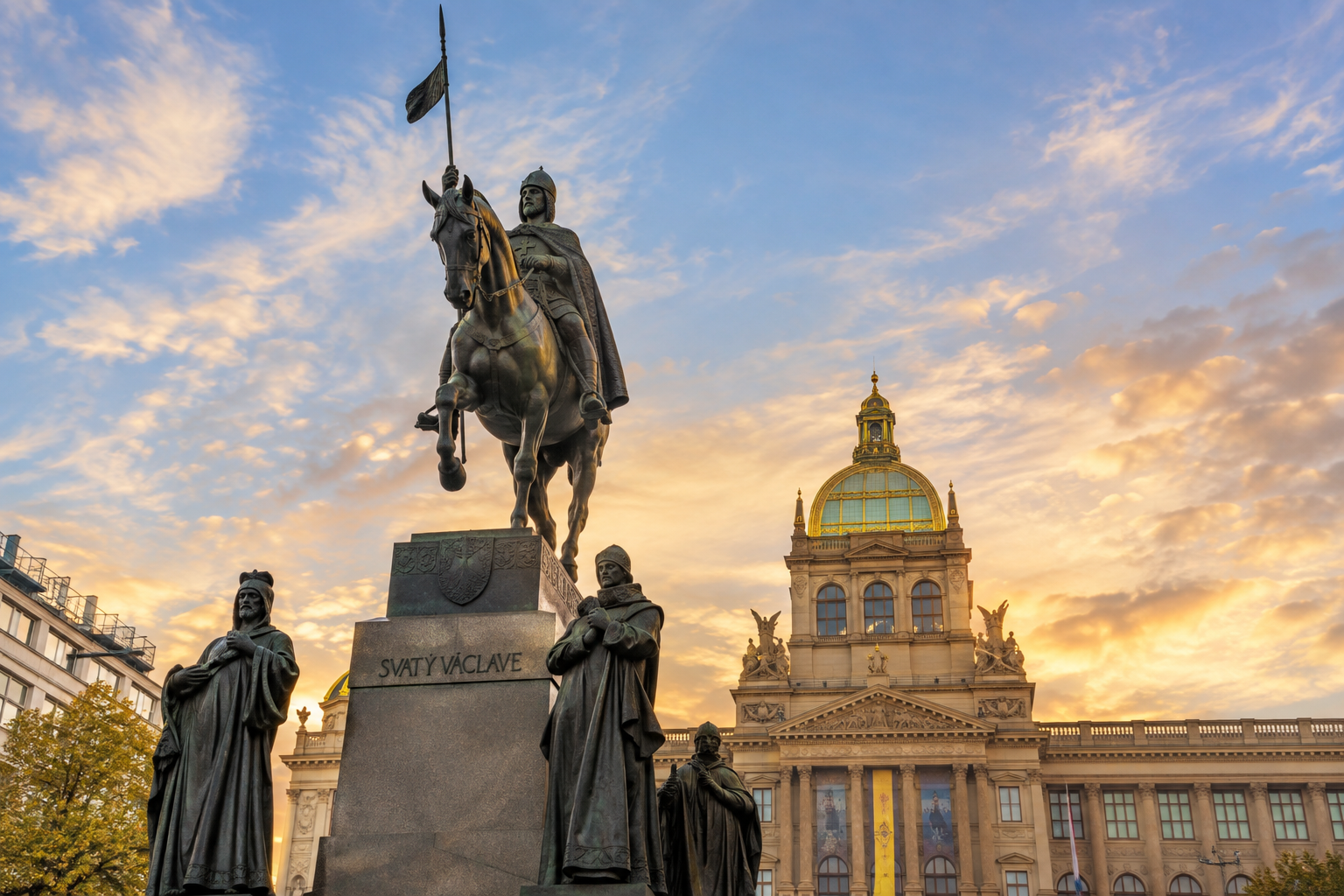
Over the centuries, Wenceslas became a symbol of the Czech lands themselves. His name appeared especially during difficult moments in Czech history and people saw him as a protector of the country and a symbol of its survival. This is also why one of Prague's most important squares is called Wenceslas Square. At the top of the square stands the famous equestrian statue of Saint Wenceslas by Josef Václav Myslbek, surrounded by other Czech patron saints. The statue became an important meeting place during major moments of modern Czech history, including the Velvet Revolution of 1989. There is also an old Czech legend connected with Blaník Mountain. According to the legend, an army of knights is sleeping inside the mountain. When the Czech lands are in their greatest danger, the knights will wake up and come to help. In later versions of the story, Saint Wenceslas leads them.
A Very Different Saint Wenceslas
National symbols are not always presented in the way we expect. Only a few minutes from the traditional statue on Wenceslas Square, we can find a very different Wenceslas inside Lucerna Passage. Czech artist David Černý created the provocative sculpture Horse in 1999. Saint Wenceslas is sitting on the belly of a dead horse hanging upside down from the ceiling. It is an ironic version of the famous statue on Wenceslas Square and also shows something quite typical of Czech culture: Czechs can respect their national symbols, but they can also question them, make fun of them and look at them with irony.
What Does Wenceslas Represent Today?
The historical Wenceslas was a medieval prince who lived more than a thousand years ago, but the Saint Wenceslas we know today is much more than that. He became an image of the good ruler, protector of the weak and patron of the Czech lands. His story also raises questions that are still relevant today: How should a small country deal with stronger neighbours? Is compromise a sign of wisdom or weakness? How much independence should a country give up for security? And what makes a good leader? Perhaps this is why Wenceslas has remained important for more than a thousand years. He was not the most powerful Czech ruler or the greatest warrior, but he became the eternal patron and symbolic protector of the Czech lands.